Hello everyone!
This is Riku from the Asaka Lab!
On September 8, the Asaka Laboratory held a one-day seminar at the Yokohama Campus as a substitute for the training camp that had been cancelled due to the typhoon.
It was disappointing that the camp—an event students and faculty alike had been looking forward to after months of planning and venue selection—could not go ahead; however, the one-day seminar turned out to be a truly enjoyable and productive experience.
In this post, I’d like to share the details and highlights of the seminar.
[Morning Session]
In the morning session, we began by reviewing our activities from the first term and confirming how we would proceed with the case studies and graduation research projects scheduled for the second term.
We also reviewed details regarding the booth we ran at the school festival—which took place over the weekend of the "One-Day Seminar"—and confirmed the venue for the social gathering held after the seminar concluded.
Next, we engaged in the main activity of the One-Day Seminar: a group work session titled "Conveying Research Content Through Diagrams." Working in mixed-grade groups of four, we took on the challenge of creating a single illustration (a "Before/After" diagram) that could clearly explain the background, issues, and proposed improvements of our graduation research projects to someone hearing about them for the first time. To ensure efficient discussion based on a shared visual concept, the groups sketched rough diagrams on a whiteboard before ultimately converting them into digital slides.
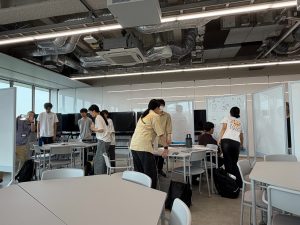
We will provide full details about the presentation in the section covering the afternoon session!
[Afternoon Session]
Following the lunch break, the third-year students held a presentation on their Python programming projects!
Using the programming learning platform "paiza Learning," the students presented on the challenges they faced and the creative approaches they took while working on their individual assignments; this served as a valuable opportunity to enhance their coding skills.
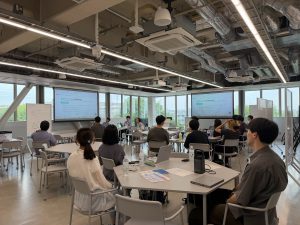
Next, we held a GitHub workshop for the third-year students.
I believe all the third-year students were able to learn how to use GitHub—a tool they will increasingly rely on for their future research activities—by getting hands-on experience with it.
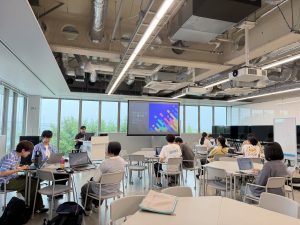
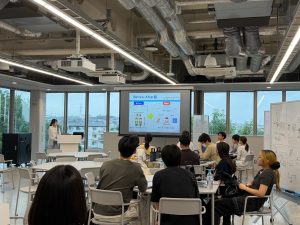
Finally, we held a presentation session for the group work.
For the fourth-year students, presenting their actual research—using "before-and-after" diagrams—served as a valuable opportunity to consider how best to convey their research objectives and the mechanisms of their proposed systems.
Meanwhile, the third-year students deepened their understanding of the fourth-year students' research by asking questions and organizing the material on a whiteboard; this experience prompted them to think about the kind of research they might want to pursue in the coming years.
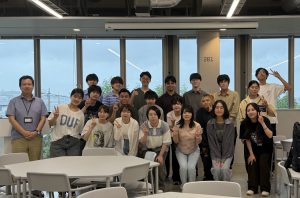
After all the scheduled activities concluded, we took a group photo.
That covers the details of our one-day seminar.
What did you think?
For third-year students, the event deepened their understanding of their seniors' research and provided a starting point for considering their own future research activities; for fourth-year students, it served as a valuable opportunity to reflect on their own work.
While there had previously been few chances for interaction across different grade levels, this seminar—and the social gathering held afterward—allowed us to build closer bonds regardless of year.
Moving forward, we intend to continue our activities while valuing not only our research but also the connections between members.
We hope this article sparks some interest in the Asaka Laboratory!
Thank you for reading to the end!
 English
 日本語