This study addresses congestion mitigation at intersections by jointly considering lane counts and pedestrian movements, an angle often treated separately in prior work.
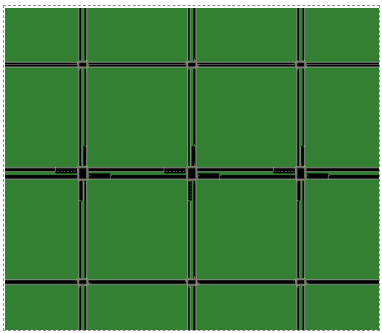
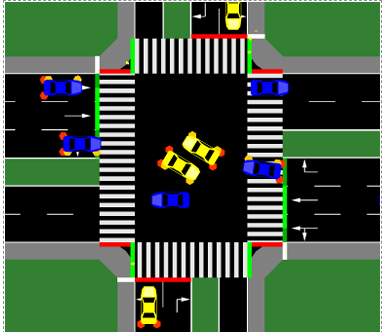
Using the traffic simulator SUMO, we modeled a grid of nine intersections formed by three one-lane north–south roads and three parallel east–west roads (one lane north, two lanes center, one lane south). Pedestrians were restricted to straight walking, and vehicle/pedestrian inflows varied by time period. We tested six scenarios that partially or uniformly increased lanes and compared queue lengths at the end of simulation.
In the scenario that expanded only selected north–south lanes (Pattern 2), the number of waiting vehicles rose to about 4.5 times the baseline and congestion worsened over time. In contrast, expanding all lanes (Pattern 6) yielded zero queues, eliminating congestion.
The findings suggest partial widening can inadvertently smooth left/right-turn movements and exacerbate queues; comprehensive, network-wide upgrades are more effective in pedestrian-rich, complex settings.
References
[1] Yamada et al., Proposal of a Traffic Signal Split Control System That Takes Pedestrian Congestion into Account (Published June 28, 2021–June 11, 2021) (Accessed April 30, 2024)
[2] Zhang et al., Proposal and Evaluation of a Congestion Mitigation Method Combining Dynamic Lane Number Adjustment and Route Planning (Updated September 8, 2023) (Accessed April 30, 2024)