This study investigated traffic congestion and collisions that occur at highway merging sections using a traffic flow simulator. Although autonomous driving technology has advanced in recent years, safe lane-changing technology under various traffic and road conditions still remains a challenge.
In this study, simulations were conducted for the Ikarigaseki Interchange in Hirakawa City, Aomori Prefecture, Japan, using SUMO (Simulation of Urban MObility), a traffic flow simulator, and OSM (OpenStreetMap), which provides map data. Vehicles traveling on the main road and vehicles entering from the merging lane were set in the simulation, and the numbers of collisions and teleports were recorded. In this study, collisions were treated as accidents, and teleports were used as an indicator of traffic congestion.
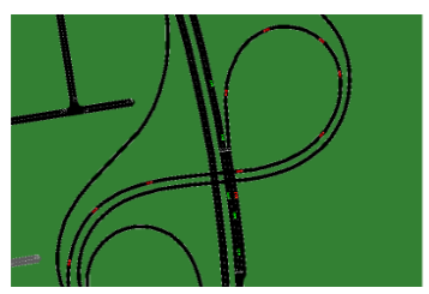
The simulation conditions were changed by varying minGap, acceleration, and the number of lanes. Here, minGap represents the minimum gap between vehicles, and acceleration represents how quickly vehicles can increase their speed. Figure 1 shows the simulation screen of the Ikarigaseki Interchange, where the number of lanes on the main road was increased from two to three. As a result, the number of incidents decreased from 141 in the two-lane case to 108 in the three-lane case. In addition, shorter minGap values reduced the number of collisions and congestion events. Larger acceleration values also reduced collisions and congestion because merging vehicles could more easily adjust their speed to that of vehicles on the main road.
These results suggest that the minimum gap between vehicles, acceleration, and the number of lanes affect traffic safety at highway merging sections. Future work will examine simulation conditions that can reduce collisions and congestion events to nearly zero.