2026 Tokyo City University Prioritized Studies

ORBIT

Research Unit for Intelligent Optimization Technologies

Optimization Research Base for Intelligent Technologies

From a person-dependent craft to a reproducible scientific foundation for deep-learning hyperparameter search.
We fuse evolutionary computation with combinatorial optimization and introduce a new metric —
Optimization Ease Score (OES) — that captures accuracy, stability, reproducibility and efficiency.

Scroll
Mission

Turning a craft into a science.

ORBIT (Optimization Research Base for Intelligent Technologies) is dedicated to transforming the complex parameter search that governs deep-learning performance — today reliant on experience and intuition — into a reproducible and sustainable technological foundation. By integrating evolutionary computation and combinatorial optimization, ORBIT develops a search framework capable of stably achieving high performance under limited computational resources, even for realistic problems with both continuous and discrete variables. We propose a new metric, the Optimization Ease Score (OES), that evaluates not only performance but also attainment, stability and reproducibility.

Evolutionary computation for continuous variables

Advanced PSO and evolutionary algorithms reach high-quality solutions efficiently — even in noisy, multimodal real-world landscapes.

Combinatorial optimization for discrete variables

Local search, neighborhood design, and constrained exploration efficiently navigate model structures and discrete configurations.

OES — a new metric of optimization ease

Beyond peak accuracy: we quantify how stably, reproducibly and cheaply anyone can reach high performance, making AI development truly reproducible.

Approach · Research Framework

Challenge → Approach → Outcome

Today's deep-learning workflow depends on expert trial-and-error, sacrificing both cost and reproducibility. ORBIT combines two optimization technologies with a new evaluation metric, OES, to deliver a next-generation AI development platform anyone can use.

Current Challenges

Costly trial-and-error

Substantial computational resources are wasted on tuning, inflating development cost.

Person-dependent tuning

Reliance on expert experience reduces reproducibility and concentrates expertise in individuals.

Complex mixed variables

Continuous and discrete variables coexist — most existing tools cannot handle them jointly.

The ORBIT Approach

Evolutionary × Continuous

Swarm and evolutionary methods efficiently search continuous hyperparameters.

Combinatorial × Discrete

Heuristic search and neighborhood design unify mixed-variable HPO.

OES — new evaluation axis

A metric that includes stability, reproducibility and efficiency, not just accuracy.

Outcomes & Vision

Reproducible AI development platform

A reliable, accessible foundation enabling anyone to deliver high-performing AI.

Efficient use of compute resources

Early stopping, weight inheritance and parallelization reduce cost and footprint.

Open-source release

Results are released openly to advance academia and industry.

Key Concept

Optimization Ease Score (OES)

Measure not only accuracy — measure ease.

ORBIT proposes Optimization Ease Score (OES) as a new axis for evaluating deep-learning models. Conventional benchmarks compare peak accuracy alone, ignoring the questions that matter in practice: does it work for anyone, and can it be reproduced under realistic budgets?

OES evaluates a model together with its optimization procedure across four dimensions — attainment, stability, reproducibility, and computational efficiency — capturing how usable and how shareable an AI system really is.

Accuracy
High attainment
Stability
Stable convergence
Reproducibility
Reliable replication
Efficiency
Resource-aware
OES
Optimization Ease Score
Concept Figures

The big picture

Background, challenges, approach and vision — at a single glance.

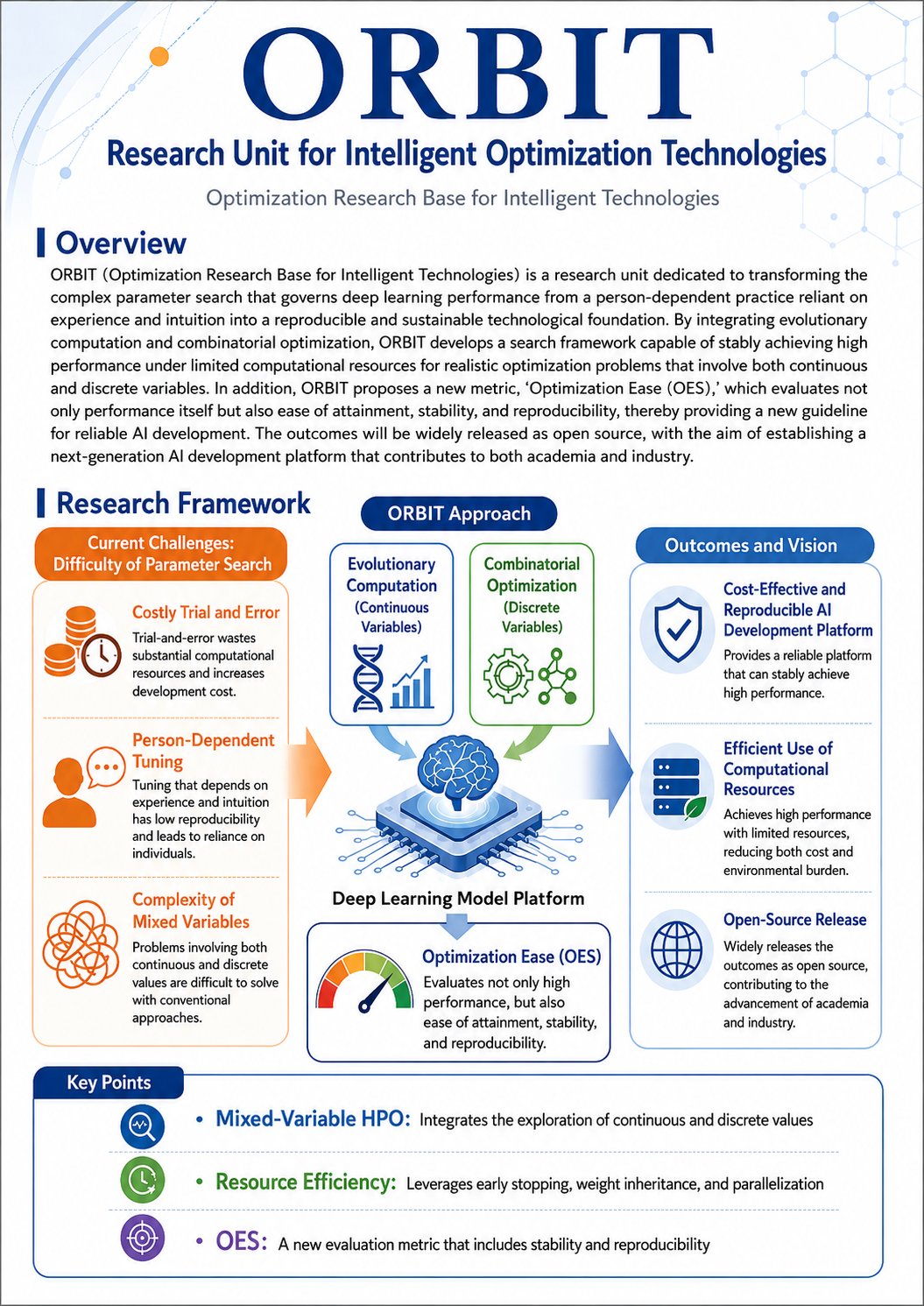
ORBIT research overview poster (English)
Research overview poster (English)
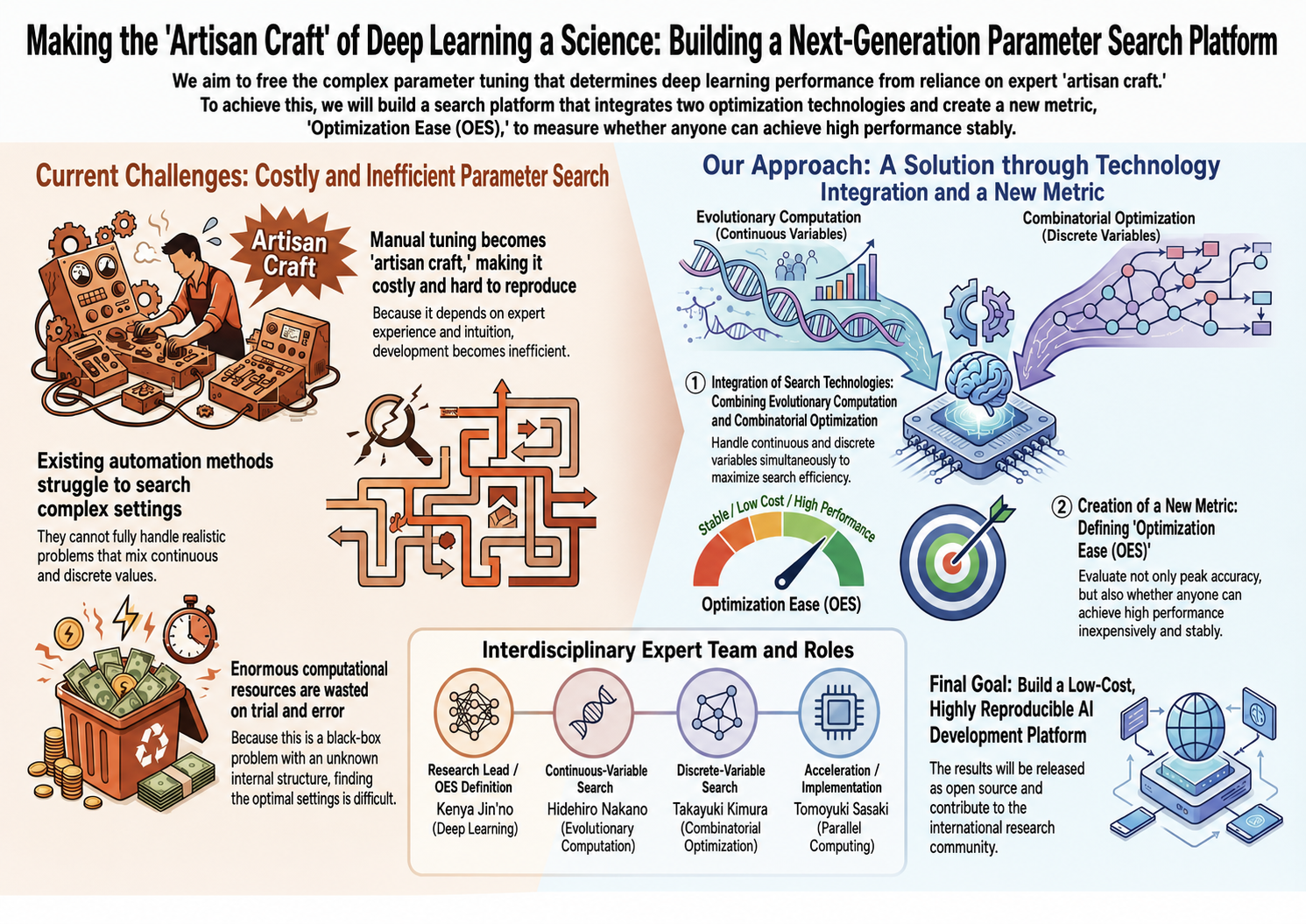
ORBIT concept diagram (English)
Concept diagram — turning the craft of deep-learning tuning into science: a next-generation parameter-search platform
Members

An interdisciplinary expert team

Four researchers spanning deep learning, evolutionary computation, combinatorial optimization, and parallel computing form ORBIT.

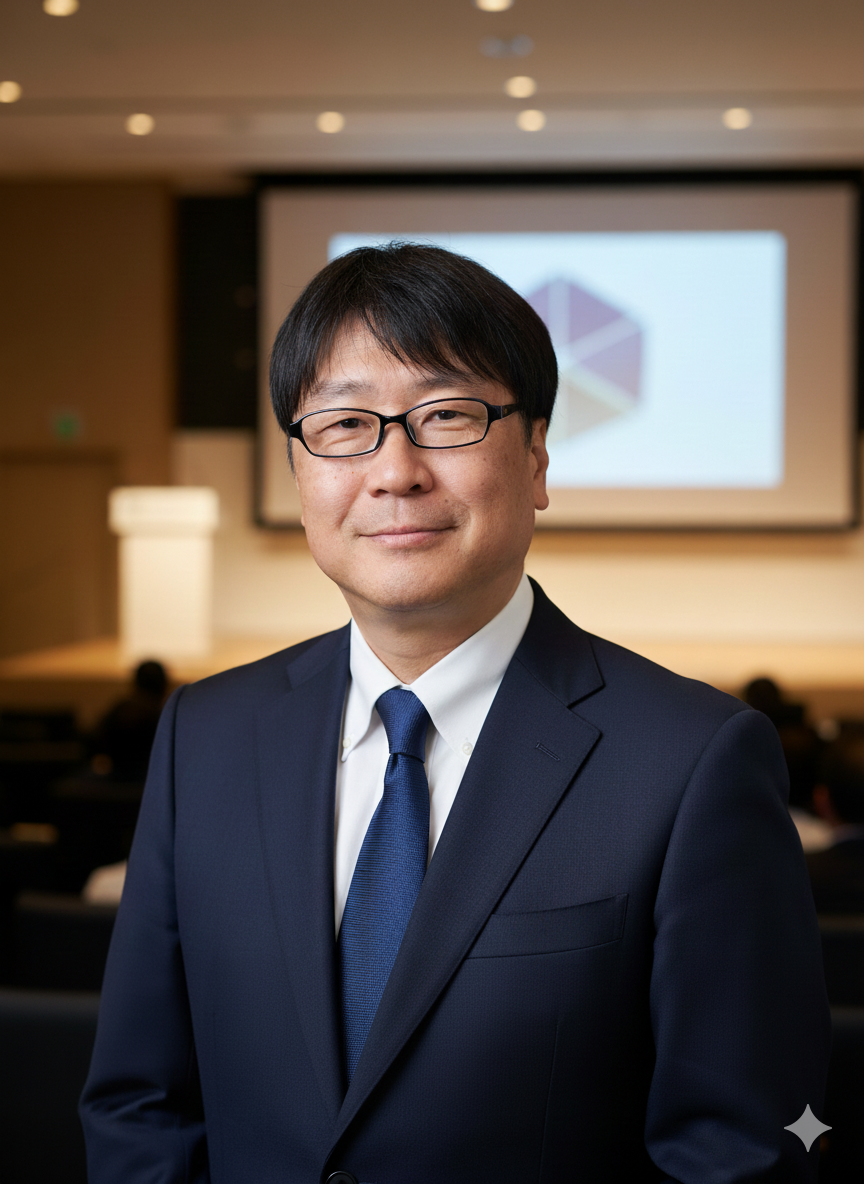
Prof. Kenya Jin'no
Principal Investigator

Kenya Jin'no

Professor — Deep Learning & OES Design

Building on deep learning and internal-representation analysis, leads task and evaluation design, the definition and validation of OES, integration of the framework, and overall program management — expanding model evaluation from accuracy to stability, reproducibility and robustness.

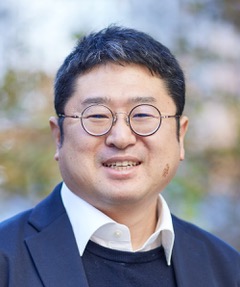
Deep Learning OES Integration
Prof. Hidehiro Nakano
Co-Investigator

Hidehiro Nakano

Professor — Evolutionary Computation

Leads continuous-variable hyperparameter optimization design, leveraging research in evolutionary computation and swarm intelligence — advancing PSO and noise-robust search to support deep-learning HPO.

Evolutionary PSO Continuous
Prof. Takayuki Kimura
Co-Investigator

Takayuki Kimura

Professor — Combinatorial Optimization

Drives the design of discrete and structural-variable search, applying local search, neighborhood design and constrained heuristics to model-structure selection and combinatorial configuration of deep-learning models.

Combinatorial Heuristics Discrete
Assoc. Prof. Tomoyuki Sasaki
Co-Investigator

Tomoyuki Sasaki

Associate Professor — Implementation & Acceleration

Responsible for parallelization, high-performance implementation and computational-resource efficiency — enabling large-scale searches to run on practical hardware budgets.

Parallel Acceleration Implementation
Publications

Research backing each role

Kenya Jin'no / Deep Learning & OES
  • Analysis of particle swarm optimization by dynamical systems theory — Kenya Jin'no. Nonlinear Theory and Its Applications, IEICE, 12(2), 118–132, 2021.
  • Swarm Intelligence Optimization Using Multiple Distributions Adapted to the Geometric Structure of Objective Functions — Reiji Wakatsuki, Kenya Jin'no. JCSSE 2026.
  • Analysis of the Island Class Structure in Dimension-Deficient Deep Classifiers — Mizuki Dai, Kenya Jin'no. Nonlinear Theory and Its Applications, IEICE, 17(3), 2026.
Hidehiro Nakano / Evolutionary Computation
  • A Particle Swarm Optimizer based on spiking oscillators with dynamic thresholds for velocity vectors — A. Ali, T. Sasaki, H. Nakano. Nonlinear Theory and Its Applications, IEICE, 16(3), 601–621, 2025.
  • Effectiveness of the Ring 1-way network for optimizer based on spiking-neural oscillator networks — T. Sasaki, H. Nakano. Nonlinear Theory and Its Applications, IEICE, 16(1), 96–119, 2025.
  • An efficient reinforcement learning method for dynamic environments using short term adjustment — H. Nakano, S. Takada, S. Arai, A. Miyauchi. 2005.
Takayuki Kimura / Combinatorial Optimization
  • A metaheuristic strategy for solving capacitated vehicle routing problem by using chaotic dynamics — F. Guo, T. Matsuura, T. Kimura, T. Ikeguchi. Nonlinear Theory and Its Applications, IEICE, 17(1), 279–294, 2026.
  • A Study on a Routing Method Using Chaotic Neurodynamics and Degree Information — Y. Morita, T. Kimura, K. Jin'no et al. 2017 RISP International Workshop on Nonlinear Circuits, Communications and Signal Processing, 217–220, 2017.
  • Simulation of Dynamic Taxi Ride-Sharing Problem with One Attribute for Passengers — H. Abiko, T. Kimura, T. Matsuura. Proc. of NOLTA 2020, 417–420, 2020.
Tomoyuki Sasaki / Implementation & Acceleration
  • A Particle Swarm Optimizer based on spiking oscillators with dynamic thresholds for velocity vectors — A. Ali, T. Sasaki, H. Nakano. Nonlinear Theory and Its Applications, IEICE, 16(3), 601–621, 2025.
  • Effectiveness of the Ring 1-way network for optimizer based on spiking-neural oscillator networks — T. Sasaki, H. Nakano. Nonlinear Theory and Its Applications, IEICE, 16(1), 96–119, 2025.
  • A piecewise-linear particle swarm optimizer with locally-coupled topology — T. Sasaki, H. Nakano. Proc. of NOLTA 2017, 580–583, 2017.