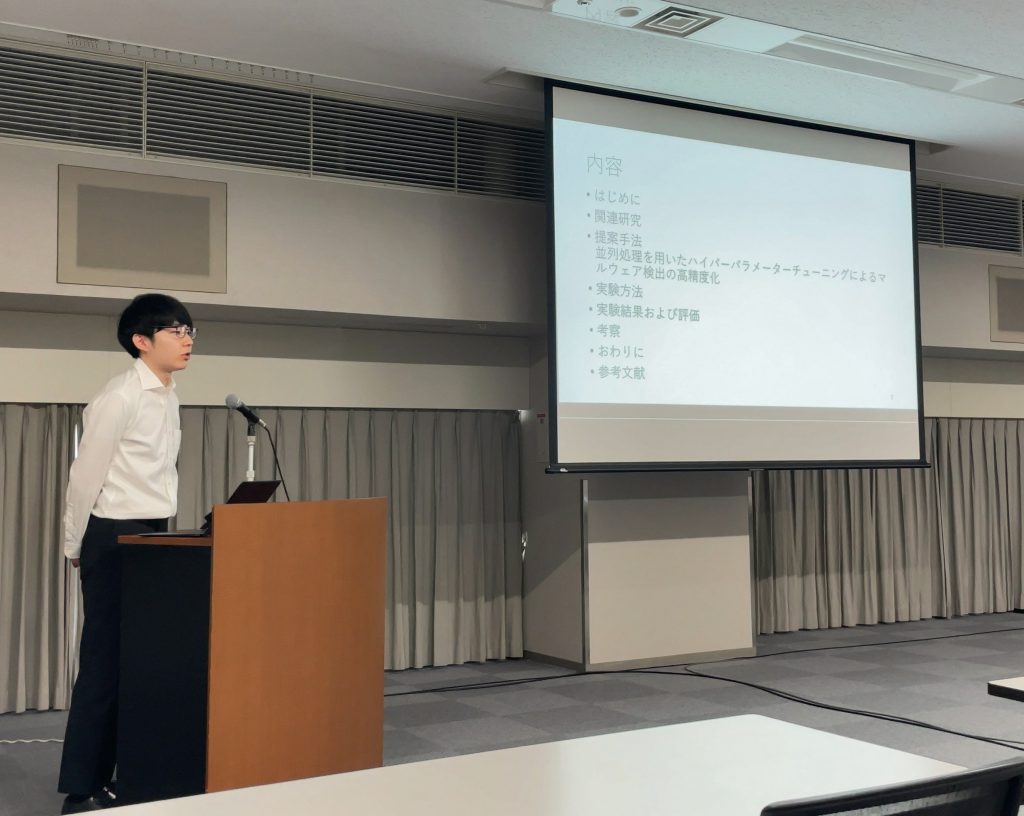
M1 student Mr. Sangawa participated in the 106th Computer Security and 56th Security Psychology and Trust Joint Research Presentation Meeting held in Sapporo, Hokkaido, in July 2024, and presented his research.
This study was presented at the Computer Security Group (CSEC) and aims to improve the accuracy of malware detection through parallelized hyperparameter tuning. In recent years, cyberattacks such as ransomware incidents targeting medical institutions have caused serious social impacts, highlighting the need for detection techniques that can effectively handle previously unseen malware.
In this research, we focus on machine learning–based malware detection models and propose a method to efficiently optimize hyperparameters, which significantly influence model performance, by parallelizing the processes of parameter selection, model training, and evaluation. The proposed method was applied to five machine learning algorithms, including Random Forest, and evaluated using Windows and Android malware datasets. Experimental results demonstrate that the proposed approach achieves higher detection accuracy than previous studies and maintains strong performance against unseen malware samples.