In recent years, remote communication, including online meetings and distance learning, has become increasingly common, making it more important to understand people’s emotions through on-screen facial expressions.
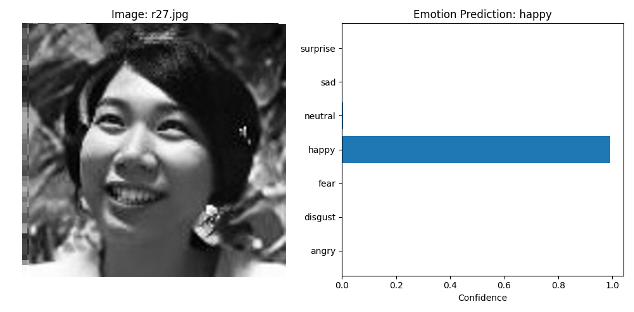
This study investigates an emotion recognition method for remote environments using an AI-based facial image classification model. Experimental results showed that while the existing model achieved high accuracy in recognizing happiness, it performed poorly in classifying emotions such as disgust and surprise, indicating that it was not well suited to remote communication environments(Figure 1). To address this issue, the study focused on the remote-specific states of fatigue and engagement, redesigned the emotion labels, and constructed a new dataset for model training. The improved model demonstrated better emotion recognition performance in remote environments. In addition, a web-based application was developed that allows users to upload facial images and instantly view the predicted emotion along with confidence scores for each category.
Future work will focus on expanding the dataset and incorporating dynamic facial expressions to develop a more accurate and practical emotion recognition system.