In this study, we investigated how the attractiveness of individual faces influences the perceived attractiveness of a group. In recent years, determining which facial features are preferred has become an important factor in the idol industry; however, such judgments often rely on the subjective opinions of producers, resulting in limited reproducibility.
To address this issue, we employed an AI-based face generation tool (Generated Photos[1]) capable of specifying attributes such as gender, age, and hairstyle. We generated facial images of Asian males and used 70 images for individual evaluations and 36 images for group evaluations. First, we conducted a survey using a “beauty score,” a 1–5 rating scale quantifying facial attractiveness, and calculated the average score for each face. The highest-rated face received a score of 4.3571, while the lowest-rated face scored 1.5.
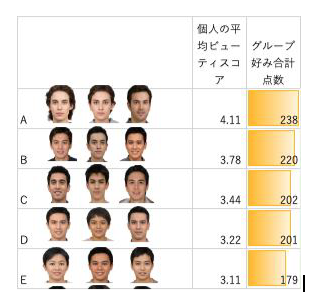
Next, we created twelve groups consisting of three individuals each and conducted a survey in which participants ranked the groups based on preference. According to the aggregated results, the highest-rated group was labeled Group A, and the lowest-rated group was labeled Group L.
The analysis revealed a clear trend: groups containing individuals with higher beauty scores tended to receive higher overall attractiveness ratings. Conversely, the inclusion of an individual with an extremely low attractiveness score substantially reduced the group’s overall evaluation. These findings demonstrate that the attractiveness of individuals significantly influences group-level attractiveness assessments.
Although limitations remain, including the sample size, the results indicate potential applications in fields such as idol development and marketing.
References
[1] Generated Photos, Available: https://generated.photos/, Accessed: May 11, 2023.